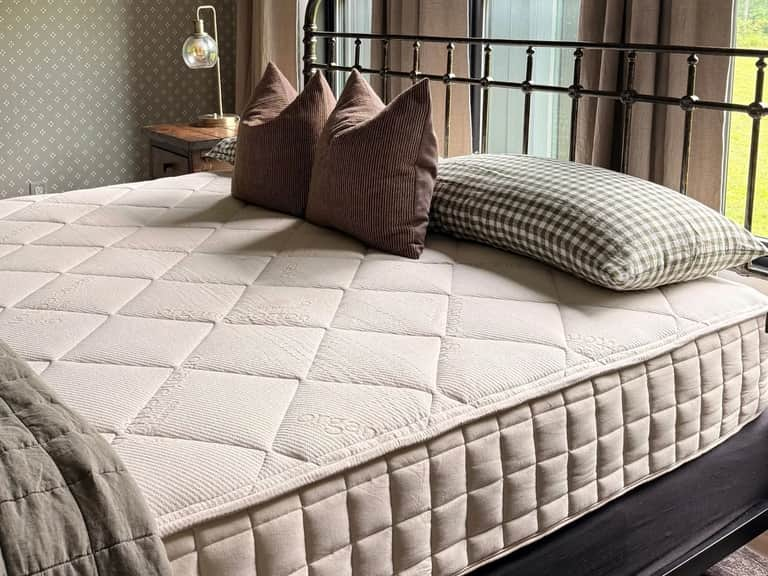
Mattress materials guide
Natural Latex Mattress Layers: How Dunlop and Talalay Construction Differ
Dunlop and Talalay are two methods of making latex foam, not simple labels for “firm” and “soft.” Their construction can influence feel and consistency, but the complete mattress design—layer thickness, firmness, cover, and support system—matters just as much.
A practical guide to understanding latex mattress construction and comparing options with confidence.
Latex has a particular reputation in the mattress world: springy rather than slow-moving, cushioning without the deep “sinking” sensation many people associate with some foams, and available in constructions that range from gently yielding to distinctly supportive. But “latex mattress” does not describe one uniform experience. A bed may use latex in a single comfort layer, across several stacked layers, or as part of a hybrid with coils. Even two mattresses that both list natural latex can feel markedly different.
One reason is the process used to turn liquid latex into foam. The names most often encountered are Dunlop and Talalay. Each refers to a manufacturing method, and each can produce useful mattress material. The terms help explain how a latex layer was made; they do not, on their own, tell you whether a complete mattress will suit your body, sleep position, or preferences.
That distinction is essential when shopping. A process name is a clue, not a verdict. To understand how a bed may perform, look beyond the label to the specific layer’s firmness, thickness, position, and role in the overall design. This guide unpacks those details and offers a straightforward way to compare natural latex mattresses without relying on shorthand alone.
What Dunlop and Talalay actually describe
Dunlop and Talalay describe different ways of producing latex foam. In both cases, liquid latex is aerated and processed into a foam structure. The exact sequence differs, affecting how the foam is formed and the characteristics manufacturers can achieve. Neither name is a firmness rating, a certification, or a complete measure of material quality.
Broadly speaking, Dunlop latex is poured into a mold, heated to set, and then washed and dried. Talalay production involves filling a mold partway, creating a vacuum to distribute the latex, freezing the material, and then heating it to complete the process. The resulting foams may differ in structure and feel, but product-level outcomes also depend on formulation, density, thickness, and the choices made when assembling the mattress.
It is tempting to translate the names into a neat comparison—Dunlop means firm, Talalay means soft—but that is too simple. Both processes can be used to make latex in a range of firmnesses. A soft Dunlop layer may feel more yielding than a firm Talalay layer. Without details about the particular product, the process name cannot settle the question of comfort.
Also distinguish the process from the source of the latex. “Natural” generally refers to latex derived from rubber-tree sap, while “synthetic” latex is made from petrochemical ingredients. Some products combine natural and synthetic latex. Dunlop and Talalay can be manufacturing descriptions; they do not alone establish whether a layer is natural, blended, or synthetic. When material origin matters to you, check the manufacturer’s precise composition information and relevant certifications rather than inferring it from the process name.
Dunlop latex: the construction and typical feel
In the Dunlop process, latex is poured into a mold and heated to form a resilient foam. A Dunlop layer is often described as having a denser or more grounded feel than a comparable Talalay layer. Some sleepers experience it as steady and substantial, with less of a buoyant, cloudlike sensation. These descriptions are tendencies, not guarantees: formulation and firmness can change the feel significantly.
Dunlop latex is commonly used for both comfort and support layers. In a layered mattress, a firmer Dunlop core can provide the underlying support, while a softer layer above it cushions pressure points. In other designs, Dunlop may be the main latex component or may sit over a coil unit. The same material name can therefore appear in products with very different overall personalities.
One reason some shoppers consider Dunlop is its reputation for durability and its availability in natural-latex constructions. The practical question, however, is not whether a process has a favorable reputation in general. It is whether the specific layer is well suited to its intended role and whether the mattress maker clearly identifies its materials, dimensions, and firmness options.
When reading a product description, look for whether Dunlop is used in the comfort layer, the support core, or both. A soft upper layer can ease pressure around the shoulders and hips; a firmer lower layer may resist excessive compression. If a listing simply says “Dunlop latex” without clarifying the layer’s thickness or position, ask for those details before treating the term as a useful comfort prediction.
Talalay latex: how its process and feel are described
Talalay latex is made through a process that includes vacuum expansion and freezing before the material is fully cured. The process can create a relatively consistent foam structure throughout the molded layer. Talalay is often described as lighter, more buoyant, or more responsive than Dunlop. Some people enjoy that lively surface; others prefer the more settled sensation they associate with a denser latex layer.
Those familiar descriptions can help you imagine possible differences, but they are not a substitute for specifications. A particular Talalay product can be firm, and a particular Dunlop product can be soft. The cover, quilting, underlying layer, and mattress foundation all influence what you feel when you lie down. Even a layer that feels springy on its own may feel different when placed beneath a thick wool quilt or above a firm support core.
Talalay is often selected for comfort layers, where responsiveness and pressure relief are key concerns. It can also be combined with other materials. A mattress might use Talalay near the surface and a different latex formulation below, or pair latex with coils. To evaluate the design, find out what each layer contributes rather than assuming that one process accounts for the whole mattress.
Shoppers may also see Talalay described as natural, blended, or made with a stated proportion of natural latex. Treat these as separate questions: the manufacturing method, the source and blend of the latex, and the certifications or testing that apply to the finished product. Each answers something different.
Dunlop vs. Talalay: a useful comparison without the myths
Both processes create latex foam that can be used in a mattress. In broad terms, Dunlop is frequently associated with a denser, more grounded sensation, while Talalay is frequently associated with a lighter, more buoyant one. But a shopper should read those descriptions as common impressions—not fixed rules. The firmness and construction of the actual mattress can outweigh the process difference.
Instead of asking which process is universally better, compare the layer’s job and the design around it. A latex comfort layer is intended to cushion and respond to the body. A support layer helps hold the sleeper in a stable position. A hybrid’s coil unit adds another source of support and responsiveness. One mattress may use different materials in those roles; another may rely on latex throughout.
When comparing products, make a note of the following:
- Layer position: Is the latex at the surface, in the middle, or forming the support core?
- Layer thickness: How many inches of latex are used, and what materials are above or below it?
- Firmness description: Is the firmness specified for the latex layer, the complete mattress, or both?
- Material composition: Is the latex natural, synthetic, or blended, and is that information clearly stated?
- Other components: Does the mattress include coils, wool, cotton, or foam that will affect its feel?
- Trial and return terms: Can you test the mattress at home, and what conditions apply if it does not suit you?
This checklist shifts attention from category labels to verifiable construction. It also helps make comparisons fairer: a thin latex comfort layer over coils is not directly equivalent to a thick, all-latex mattress, even if both use the same process.
How layer design shapes comfort and support
A mattress works as a system. Its upper layers affect initial cushioning and pressure relief; its lower layers contribute to support and help limit how far the body settles. The cover and quilting can soften or firm the first impression. The bed frame or foundation can influence the mattress’s stability. The latex process is only one part of this arrangement.
Thickness matters because it influences how much material sits between the sleeper and the support core. A thicker comfort layer may permit more contouring, while a thinner one can create a closer connection to firmer layers underneath. Yet thickness cannot predict comfort by itself. A soft, thin layer may compress differently from a firm, thicker layer, and the sleeper’s body shape and weight affect how each responds.
Firmness labels also require caution. They are not universally standardized across mattress makers, and a “medium” from one company may not match a “medium” from another. A firm latex layer paired with plush quilting may feel different from a firm layer beneath a taut cover. Ask whether a firmness scale refers to the whole bed or an individual component, and whether firmness options change the latex, the support core, or both.
For people sharing a bed, consider whether each sleeper needs the same feel. Some latex mattresses offer split comfort choices, while others are built as a single, consistent surface. Motion response and edge stability depend on the full construction, not merely on whether the foam is Dunlop or Talalay. If these features matter, look for specific product information and test the bed when possible.
Connect mattress construction to your sleeping position
Sleep position is a helpful starting point, not a formula. Side sleepers often need enough cushioning around the shoulders and hips to reduce pressure, while maintaining support through the torso. Back sleepers may favor a balanced surface that cushions without allowing the hips to sink excessively. Stomach sleepers commonly look for a firmer, more supportive feel, though individual comfort and body proportions vary.
Latex’s responsiveness can make position changes feel easy for some sleepers. Unlike materials that slowly contour and recover, latex generally responds quickly when pressure shifts. That characteristic can be appealing to people who move during the night, but personal preference is decisive. A responsive surface is not automatically comfortable for everyone.
Think in terms of outcomes rather than labels: Does the surface ease pressure where you feel it? Does your body feel supported rather than suspended or pushed upward? Can you change positions without effort? Does the mattress remain comfortable after you have spent time on it, not just during a brief showroom test? These observations are more informative than trying to choose by process name alone.
People experiencing ongoing back, neck, or joint pain should not treat mattress selection as a substitute for medical advice. A mattress may affect comfort, but pain can have many causes. If symptoms persist or worsen, a qualified health professional can help assess them.
Reading claims, certifications, and care information
Natural latex is often discussed alongside organic materials, low-emission claims, and environmental considerations. These terms should be checked individually. A product’s use of natural latex does not automatically establish that every component is organic or certified. Similarly, a certification may apply to a particular material or manufacturing standard rather than every part of a finished mattress.
Look for clear descriptions of the latex source and blend, the layer construction, and the scope of any certification. If a listing uses a broad phrase such as “all natural,” ask what that means for the latex, cover, adhesives, and other components. Transparent specifications are more useful than sweeping assurances, especially when you are comparing mattresses across brands.
Care instructions matter too. Latex layers are generally not intended to be machine washed, and a mattress cover may or may not be removable. Check what cleaning methods are recommended, whether the mattress should be rotated, and what the warranty requires. A waterproof protector can help guard against spills and everyday moisture, but it may also alter the surface feel or airflow slightly. Choose one that fits properly and follow its care directions.
Finally, examine the practical terms: delivery method, setup requirements, trial period, return fees, warranty coverage, and the type of foundation required. A well-described mattress is easier to assess, but the purchase conditions determine how manageable it is to discover whether the bed works for you at home.
A simple method for comparing latex mattresses
When two products seem difficult to distinguish, compare them in a consistent order. Start with the complete construction. Write down the layers from top to bottom, including material and thickness wherever the information is available. Then identify whether the latex is Dunlop or Talalay and whether it is described as natural, blended, or synthetic. Separating these facts prevents one label from standing in for the entire design.
Next, compare the intended feel and available firmness choices. Look for specific explanations of what changes between options: the latex firmness, coil unit, or another layer. If the description is vague, contact the seller with direct questions. Ask how the mattress is expected to feel relative to another model, what foundation it requires, and how the trial and returns work.
Finally, consider your own priorities. You might value a buoyant surface, strong pressure relief, natural-material documentation, a particular height, or a specific budget. Rank these priorities before shopping. A clear list can reduce the distraction of technical language and help you focus on the features you will actually live with.
- Record the full layer stack, including thicknesses and materials.
- Separate the manufacturing process from latex source and certification claims.
- Check whether firmness information describes a layer or the whole mattress.
- Consider sleep position, pressure points, temperature preferences, and movement.
- Review foundation compatibility, care instructions, warranty, and trial terms.
- Test the mattress if possible, or use the at-home trial as a structured evaluation period.
During a trial, give yourself time to assess the bed in ordinary use. Notice how you feel on waking, whether pressure builds, and whether the surface remains comfortable across your usual positions. A short first impression can be useful, but it cannot represent every night. Follow the manufacturer’s guidance on break-in periods and returns rather than waiting until the last moment to decide.
Frequently asked questions
Is Dunlop latex always firmer than Talalay?
No. Dunlop is often described as denser or more grounded, and Talalay as lighter or more buoyant, but both processes can produce different firmness levels. Compare the specifications and construction of the individual mattress.
Does Talalay mean a mattress contains natural latex?
No. Talalay describes a manufacturing process. It does not, by itself, specify whether the latex is natural, synthetic, or blended. Check the material description and any applicable certification.
Which process is better for a latex mattress?
Neither is universally better. The right choice depends on how the complete mattress feels and whether its layers suit your needs. Layer thickness, firmness, cover, support core, and your own preferences all contribute to the experience.
Can I tell a mattress’s firmness from the latex process?
Not reliably. The process name is not a standardized firmness rating. Look for product-specific firmness details and, where possible, try the mattress or use a clear home-trial policy.
Is an all-latex mattress the same as a latex hybrid?
No. An all-latex design uses latex as its principal cushioning and support material, though covers and other components are also present. A latex hybrid combines a latex layer with a different support system, often coils. The added system changes the feel and construction.
The takeaway: compare the build, not just the name
Dunlop and Talalay offer two distinct routes to latex foam, and their common feel descriptions can provide a useful first impression. Dunlop is often associated with a more substantial response; Talalay is often associated with a lighter, springier one. But neither label can tell you the exact comfort, firmness, or support of a finished mattress.
The more reliable approach is to examine the whole build: which layers are used, how thick they are, where they sit, and what the manufacturer says about firmness and material composition. Then weigh those facts against your sleep position, comfort preferences, and practical needs. Once the layers are clear, the choices become less mysterious—and the process name becomes one helpful detail among many, rather than the answer to everything.